How to Import an OST File into Outlook
In short: Outlook cannot import an OST file directly. If the OST still belongs to a working account, Outlook rebuilds it the moment that account reconnects. If the OST is orphaned, with the account gone or the server unreachable, you convert it to a PST first, then import that PST through File → Open & Export.
- Why Outlook cannot import an OST
- If the OST is linked to a working account
- If the OST is orphaned
- OST vs PST: what is the difference?
- Why can you import a PST but not an OST?
- Extract contacts or attachments from an OST file
- When the OST has hit its maximum size
- Moving an OST to a new computer
- Can a corrupted or encrypted OST be recovered?
- Frequently asked questions
Why Outlook cannot import an OST
An OST is not a portable backup the way a PST is. It is a local cache of a mailbox that lives on a server, tied to the one Outlook profile that made it. No version of Outlook lets you drop an OST into another profile, because the file only means anything next to the account it came from. Microsoft’s own documentation confirms there is no supported way to import an OST directly. So what you do next comes down to one thing: does that account still work.

Technical Executive and Staff Writer, Corbett Software
“Nearly every orphaned-OST case I see comes down to the same thing people miss. The file is useless without its account, so the real fix is converting it to PST, not hunting for an import button that does not exist.”
If the OST is linked to a working account
You do not need to import anything. Add the account back to Outlook and it rebuilds the OST from the server on its own, every folder and message intact. If the cache looks incomplete, close Outlook, rename the old .ost then open Outlook again to force a clean rebuild. If you just want a portable copy to move or keep, export a PST from inside Outlook, for free. The Import and Export wizard lives in classic Outlook (2016, 2019, 2021 and Microsoft 365).
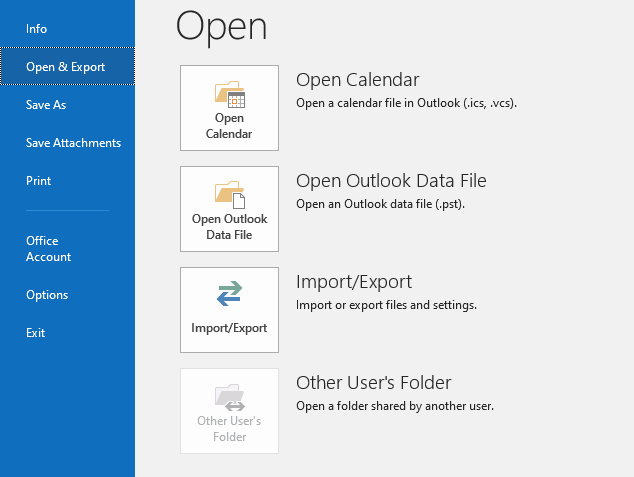
- In Outlook, go to File → Open & Export → Import/Export.

The Import and Export wizard in Outlook. - Choose Export to a file then click Next.
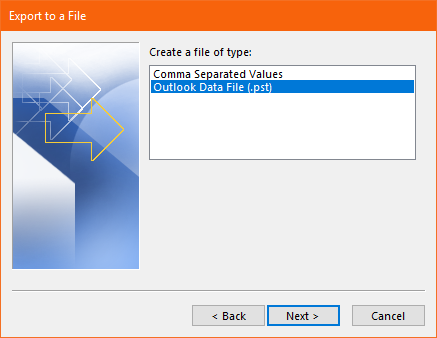
- Select Outlook Data File (.pst) then pick the account or folders to export.

Choosing the PST export format. - Tick Include subfolders, click Browse to set the location then finish to save the PST.
That PST is a portable copy any Outlook can import as a PST file on any machine.
If the OST is orphaned
An orphaned OST is one whose account is gone or whose server cannot be reached anymore, so there is nothing left to rebuild from. Now the file itself holds the only copy of that mail and you have to turn it into a PST before Outlook will touch it.
A dedicated Corbett OST to PST Converter reads the file directly, including orphaned and inaccessible ones, keeps the folder structure intact and writes a PST that opens in any Outlook. A free demo edition lets you check the result first. It runs on every edition of Windows.
Convert the OST to PST, step by step
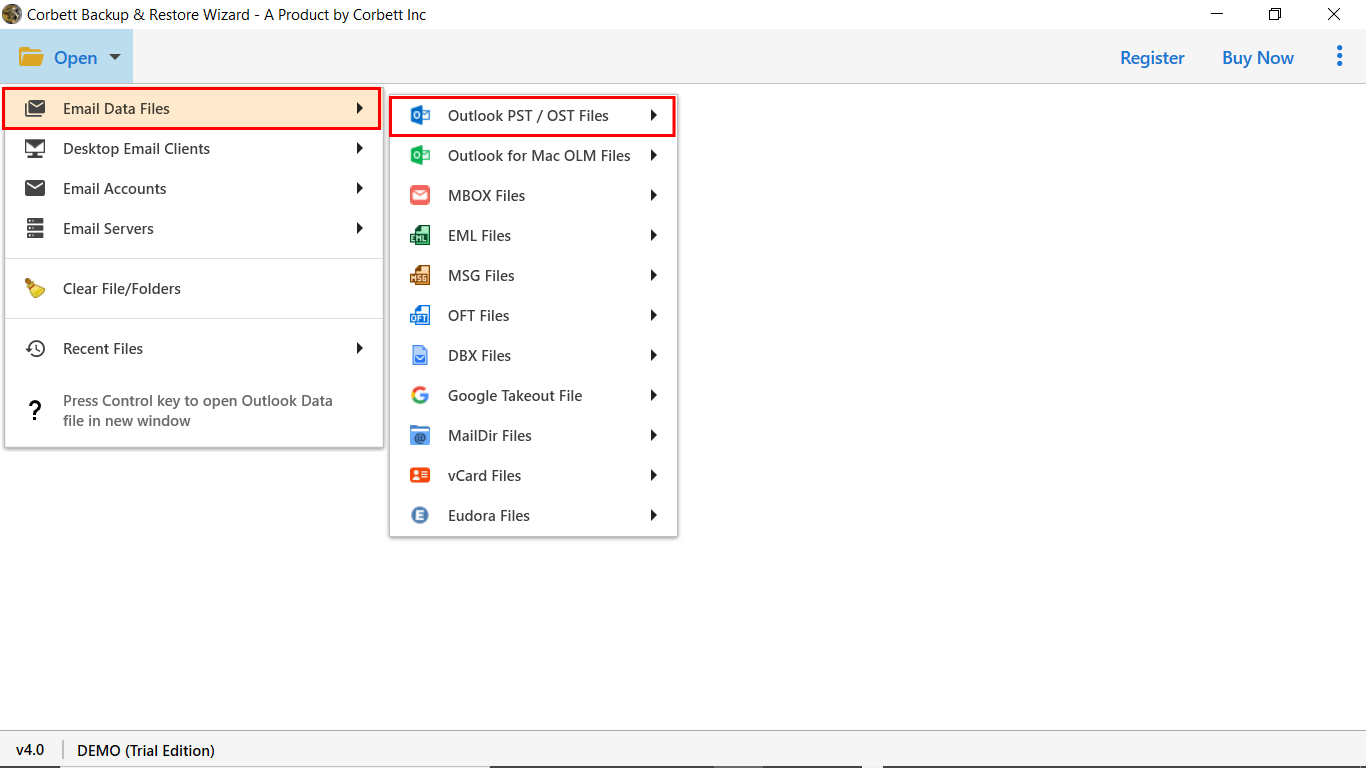
- Install and open the software, click Open, choose Email Data Files then select OST Files.

Selecting the OST file as the source. - Browse to your OST file and open it, then preview the mail to confirm it is the right file.
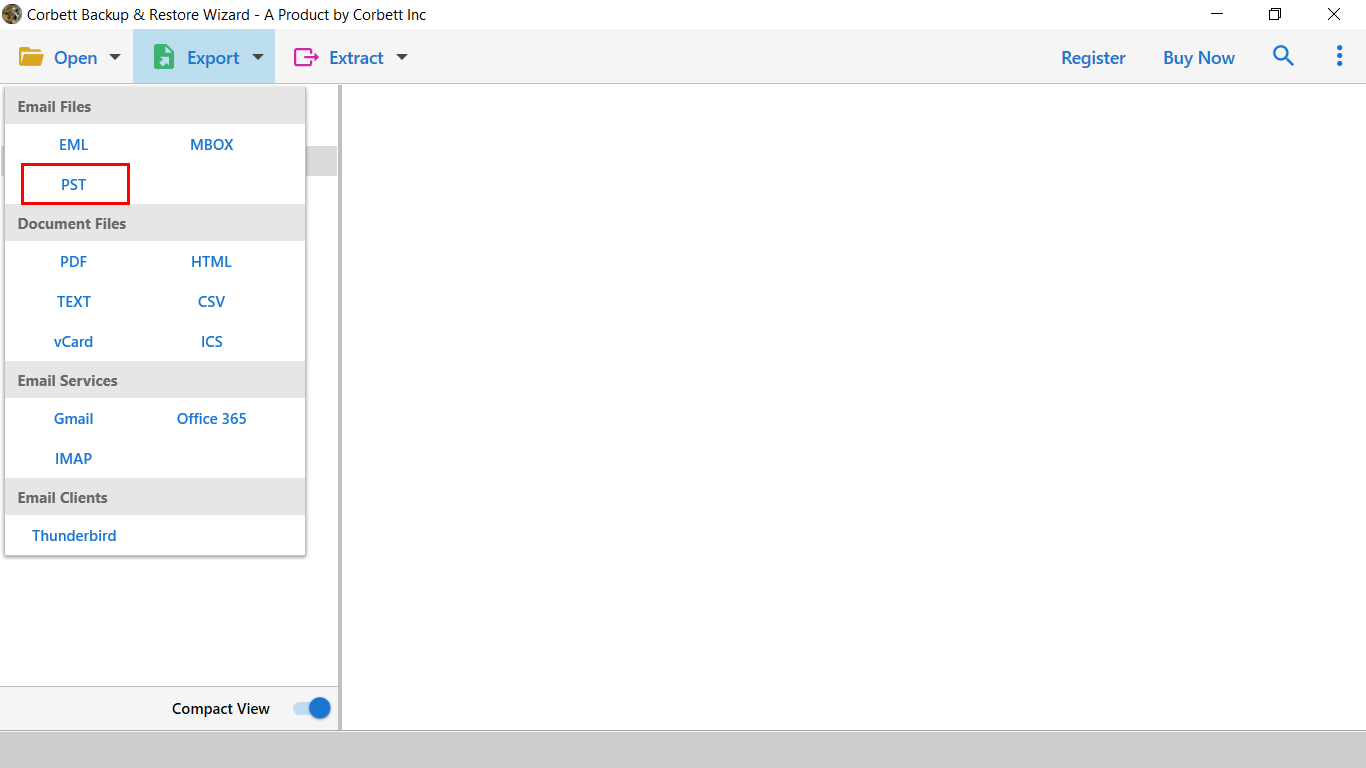
- Click Export then pick PST from the list.
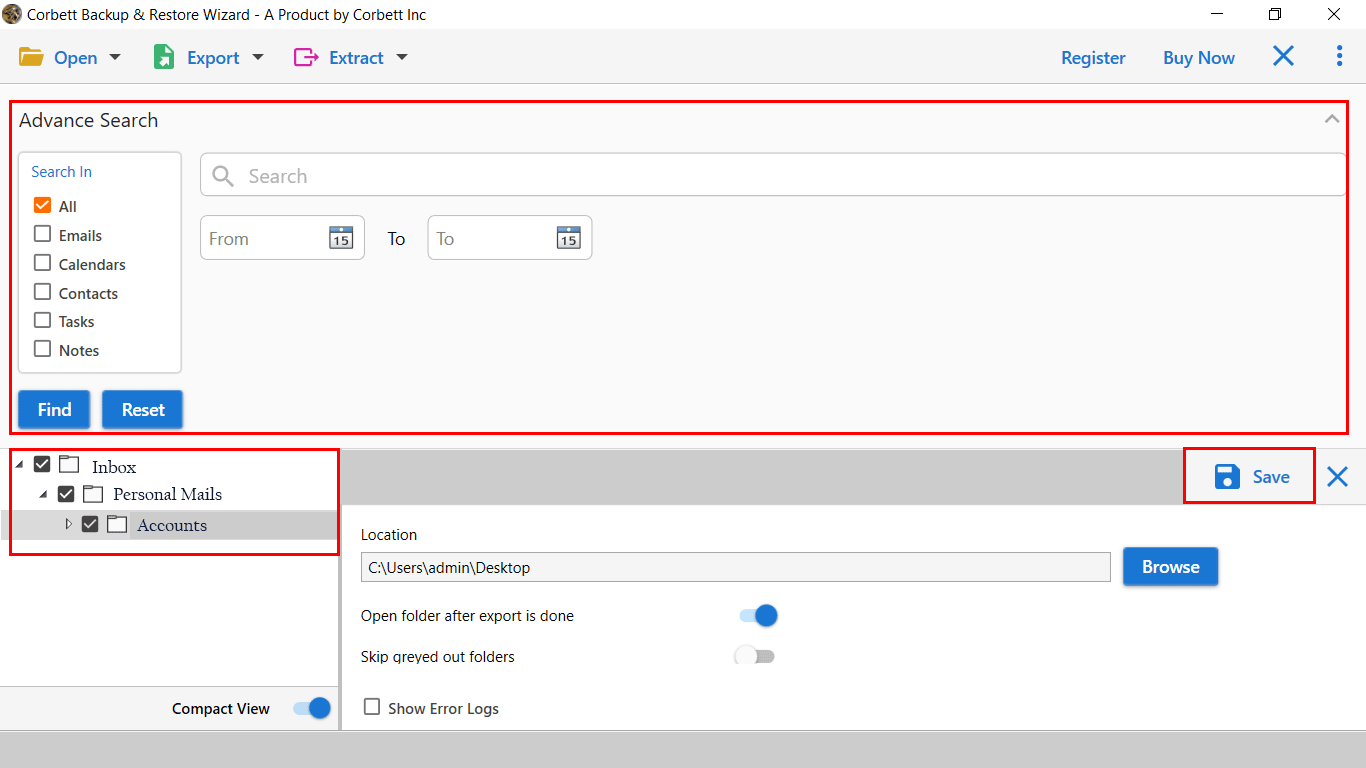
The export list with PST selected. - Choose a destination, apply any filters then click Save.
Saving the PST file. - Open classic Outlook, go to File → Open & Export → Import/Export then bring in the PST. The OST mail is now in Outlook with its folders intact.
OST vs PST: what is the difference?
A PST is a standalone file you can move, back up and open anywhere. An OST is a synced offline copy that belongs to one account and cannot be imported on its own. That one difference is why an orphaned OST has to become a PST first.
Why can you import a PST but not an OST?
The split is deliberate, not an oversight. A PST is built as a portable personal file. It is meant to be moved, copied, backed up and imported into any Outlook, so Outlook reads one from anywhere without complaint. An OST is the opposite. It is only a local cache of a mailbox that lives on a server. Outlook treats that server as the single source of truth. Reconnect the account and Outlook rebuilds the cache from the server, so there is no reason to import a loose OST and every reason not to. A detached OST with no server to reconcile against would only create conflicting, orphaned data.
There is a data-protection angle too. Because an OST stays tied to the profile and account that created it, someone cannot just copy your OST file, open it in their own Outlook and read your mail the way they could with a portable PST. In many setups the file is also bound to your Windows profile. So while Microsoft’s main reason is the cache-versus-store design, that account binding doubles as a safeguard for your mailbox data. It is fair to call it security by design, as long as you treat it as a byproduct of how an OST works rather than a lock built for the job. Anyone with the right converter can still turn a readable OST into a PST, which is exactly why the orphaned-file route above exists.
Extract contacts or attachments from an OST file
You do not have to import the whole mailbox to pull out a few items. If the account is live, open the OST in Outlook and drag the contacts or attachments you need. If it is orphaned, convert it to PST first, then take them from there. For a large or selective job, a converter that saves contacts to vCard or CSV and attachments to a folder is quicker. Step-by-step help: extract contacts from an OST file and extract attachments from an OST file.
When the OST has hit its maximum size
An OST runs into the same size ceiling as a PST, 50 GB by default on a modern Outlook. Once it fills up, mail stops syncing and Outlook starts to lag or throw errors. Clearing out space or archiving old mail usually sorts it. Full guide here: the OST has reached its maximum size.
Moving an OST to a new computer
Copying the .ost across by hand almost never works, because it is bound to the profile that created it. The clean way is to add the account on the new machine and let Outlook build a fresh OST or convert the old file to PST and bring that over. Step-by-step help: move an OST file to a new computer.
Can a corrupted or encrypted OST be recovered?
Sometimes. A mildly corrupted OST can usually be converted to PST and opened, which saves most of the mail. A badly damaged one may lose some items. An OST that your organization encrypted normally cannot be opened outside its original account at all, so check with your IT admin before you sink time into it.
Frequently asked questions
Can Outlook open an OST file directly?
No. Unlike a PST, an OST cannot be opened or imported on its own. Either reconnect the original account so Outlook rebuilds it or convert the OST to a PST and import that.
Where is my OST file stored?
By default in C:\Users\<you>\AppData\Local\Microsoft\Outlook\. To check the exact path, open classic Outlook and go to File → Account Settings → Account Settings → Data Files.
Will I lose mail by deleting the OST?
Not for a normal synced account. The mail sits on the server, so a fresh OST just downloads it all again. The exception is an orphaned OST, which holds mail that exists nowhere else, so convert it to PST before you delete anything.
Is converting an OST to PST safe?
Yes. The conversion reads the OST and writes a new PST, so it never changes the original. You end up with both files.
Can I import an OST into New Outlook?
No. New Outlook does not open local OST or PST files the way classic Outlook does. Convert the OST to a PST, then bring it in through classic Outlook. See import a PST file into Outlook for those steps.